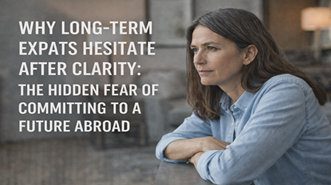
Thinking beyond yourself as a long term expat.
At some point in your life abroad, stability stops feeling like an achievement and starts feeling like a baseline. Your days are no longer shaped by uncertainty or constant adjustment. You know how things work where you live. Your finances are functional. Your routines feel familiar. Life no longer feels temporary.
And yet, something subtle begins to surface.
It is not dissatisfaction. It is not restlessness. It is not a desire to leave or start again. It is a quieter awareness that the question is no longer about whether this life works, but about what this life is meant to carry forward.
When you first moved abroad, stability was the goal. You needed to establish yourself, earn a living, navigate systems, and build something dependable enough to stand on. Every decision carried weight because so much depended on it. Over time, through effort and adaptation, that pressure eased. You built a life that holds.
What you may notice now is that stability alone does not fully engage you anymore. Not because it is insufficient, but because it creates space for a deeper question. Once survival and structure are no longer consuming your energy, your attention naturally shifts outward. You begin to think less about maintenance and more about meaning.
This shift often arrives quietly. It shows up in the way you think about time, about responsibility, about what your choices support beyond your own comfort. You may find yourself reflecting on the people who depend on you, the communities you belong to, or the example you are setting without consciously intending to. You may start to ask whether your financial life reflects not just your needs, but your values.
This is not about ambition or legacy in the traditional sense. It is not about building something larger, louder, or more impressive. It is about continuity. About what remains steady even as life continues to change.
As a long term expat, you have already learned that life abroad rarely unfolds according to a fixed plan. You have navigated transitions that required flexibility, patience, and resilience. Now, with stability in place, the work becomes different. It is less about adapting to external circumstances and more about aligning your inner compass with the life you are sustaining.
Money plays a quiet but essential role in this stage. Not as a measure of success, but as a tool for stewardship. The question becomes less about how much you earn and more about what your financial choices make possible. What do they protect? What do they support? What do they allow you to contribute without strain or sacrifice?
You may find that your relationship with money becomes more reflective. You are less interested in optimizing every outcome and more interested in creating structures that endure. You care about resilience rather than speed. About clarity rather than complexity. About decisions that will still feel sound five or ten years from now.
This is often where people begin to realize that financial planning, at its best, is not about projection or control. It is about creating a framework that can hold both the known and the unknown. One that supports your life as it evolves, rather than forcing it into a predetermined shape.
Thinking beyond yourself does not mean neglecting your own needs. It means recognizing that your stability gives you the capacity to care more deeply, more intentionally, and with greater calm. It allows you to make choices that are not reactive, but considered. Choices that take into account not just the present moment, but the longer arc of your life abroad.
This may express itself in different ways. In how you support family, whether near or far. In how you engage with your community. In how you plan for transitions that are inevitable, even if their timing is uncertain. It may also show up in a desire to simplify, to remove friction, to ensure that your financial life does not become a source of unnecessary complexity for those around you.
What matters is not the form this takes, but the intention behind it. The intention to live in a way that is coherent, sustainable, and quietly responsible. To build a life that does not just work for you, but stands up over time.
From the perspective of someone who has worked with expats across many stages of life, this moment is one of the most meaningful. It is where planning shifts from solving problems to supporting purpose. Where guidance becomes less about direction and more about discernment.
There is a particular kind of confidence that comes from knowing your life is not only stable, but thoughtfully held. That your decisions are not driven by urgency or fear, but by a clear understanding of what matters to you now. That you are not racing toward an outcome, but tending to a life that already has substance.
This stage does not require dramatic action. It requires attention. It asks you to listen to what feels important now, rather than what once felt necessary. It invites you to consider how your financial life can reflect the person you have become, not just the path you have traveled.
And it is here, in this quieter space, that thoughtful guidance can be most valuable. Not to tell you what to do, but to help you see what you are already holding. To bring structure to intentions that may feel present but undefined. To ensure that the life you have built continues to support not just your stability, but your sense of purpose.
If you recognize yourself in this stage, it may be worth having a conversation. Not because something is wrong, but because something is ready to be clarified. A conversation that respects where you are, honors what you have built, and looks calmly toward what comes next.
Because stability is not the end of the journey. It is the foundation that allows you to think beyond yourself, with confidence, care, and intention.
If you find yourself at this stage, where stability is no longer the goal and the questions feel broader and quieter, it may help to speak with someone who understands this phase of expat life. Not to fix anything, but to reflect, clarify, and ensure that what you have built continues to support where you are going. If you would like to explore that together, you are welcome to book a conversation.